
Three Ways To Get Better At Saying No

Have you ever found yourself being asked for yet another thing and just feeling so irritated and tired, there’s a hot bubble in your chest that wants explode?
Like, something that normally you’d find yourself saying yes to automatically. But this time, you’ve just hit your limit.
So how do I get better at saying no?
For many of us who struggle with saying no, we probably learned early on that if we expressed our own needs or feelings, we got shut down, blamed, iced out or yelled at – often by the very person we needed to care for us.
Staying safe and saying yes got fused and became our Autopilot.
So now as an adult, when we’re in a similar situation our Autopilot understandably kicks in: “if I say no, I’ll be shut down, blamed, iced out or yelled at”.
But this pattern is now harming us as an adult.
It still keeps others happy, but its also hurting us – leaving us feeling irritated, not seen, drained or burnt out.
So how can we get better at saying no? Here are 3 things that can help.
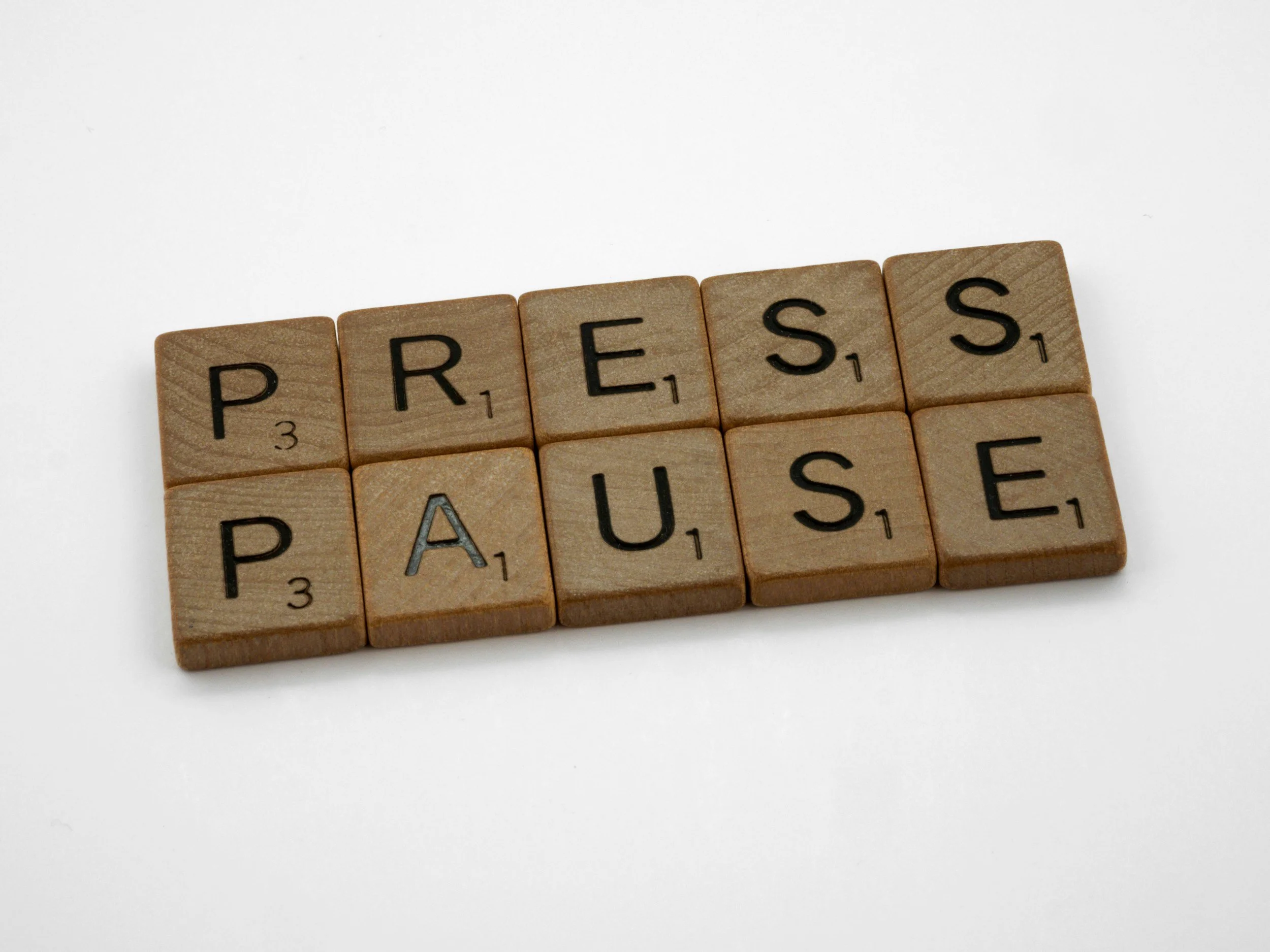
Wooden tiles spelling out ‘Press Pause’
1. Swap ‘Yes’ for ‘Let Me Think About It’
Why this helps:
Saying no straight away can often feel extremely anxiety provoking because it’s doing the opposite of what our Autopilot knows is going to keep us safe.
By swapping ‘yes’ for ‘let me come back to you’, it interrupts your Autopilot.
Hitting the pause button lets that initial feeling of dread or people-pleasing-ness ease away and gives you a beat to think: can I actually say yes or is this going to be one thing too many?
How to do it:
Try swapping ‘sure, no problem’ for something that hits the pause button and gives you a moment to think:
• ‘Can I just check something first – I’ll let you know in half an hour’.
• ‘Can I get back to you in 10?’
• ‘Let me think about it for a mo – I’ll let you know after lunch’
It can be helpful to add a period of time as it signals to the other person to let you be (and not stand awkwardly by waiting, making you feel even more hassled).

Photo cut out board at seaside
2. Ask ‘What Am I Afraid of Happening if I Say No?’
Why this helps:
You know those cut outs at the seaside, usually of a cartoon person from the 1950s? Then you put your head through the head-hole for a photo?
Our brain does something similar – we carry around a cut out in our head of the person who hurt us as a child. Then who ever we’re talking to now – we put their face into the cut out and expect them to respond in the same way.
But in this moment, you’re talking to a different person.
The chances are, they’re going to react very differently to that parent, sibling, bully or other person in your young life who could leave you feeling so scared and inadequate.
So if we can break down what the Autopilot is worried about, it gives us the chance to question whether it’s really going to happen.
How to do it:
Take a deep breath (its cheesy but I find it helps closing my eyes, putting one hand on my heart and the other on my tummy). Pause. Ask yourself:
• What am I worried is going to happen here? What’s the worst case scenario?
• Is that really going to happen or is it my Autopilot voice trying to get heard?

Man cheering and waving arms above head
3. Have a Mantra to Build Your Inner Cheerleader
Why this helps:
Our autopilot has been playing on repeat for years - it takes time and energy to change.
Coupled with that, we rarely get thanked for balancing our own needs with others. When someone is asking you for help, its unlikely they are going to end with ‘if this is too much, you can absolutely say no’.
So we need to cultivate a part that’s gonna stand up for YOU!
A mantra gives us a new thought that supports us when we need to say no.
Think of it as a mini cheerleader, sitting on your shoulder, rooting for you.
Rooting for you to have more energy, to feel more balanced, to feel less overwhelmed.
How to do it:
Choose a mantra that rings true for you. Try to practice it a couple times a day, when you’re doing something routine – like boiling a kettle, brushing your teeth or going to the loo.
Then when you need it, it’s ready to go.
Here’s a few suggestions:
• Their needs matter but so do mine
• I’m worried they’ll be upset but my needs matter too
• Caring for myself helps me care for others
• If I say yes, I’ll feel overwhelmed/tired/angry* and that will affect my ability to complete my work tasks/look after my family/sink my ability to function today*
*delete/change to whatever you need
Change takes time
If you’re feeling overwhelmed reading this, you don’t need to try it all – just chose one thing that jumps out at you and start there.
Change starts by repeating one small thing, over and over.
If you’re reading this and would like some support, please get in touch – I’d love to hear from you.